First dromedary remains found in Murcia uncovered at San Esteban
The discovery is being described as exceptional, while a hidden jar and other Andalusian-era remains are also adding to the picture of the site
Archaeologists working at Murcia’s San Esteban site have uncovered the first dromedary remains found in the city, a discovery the Ayuntamiento says opens up new lines of research into the ancient Andalusian suburb of Arrixaca. The find is being described as exceptionally rare in Iberian archaeology from the Islamic period.
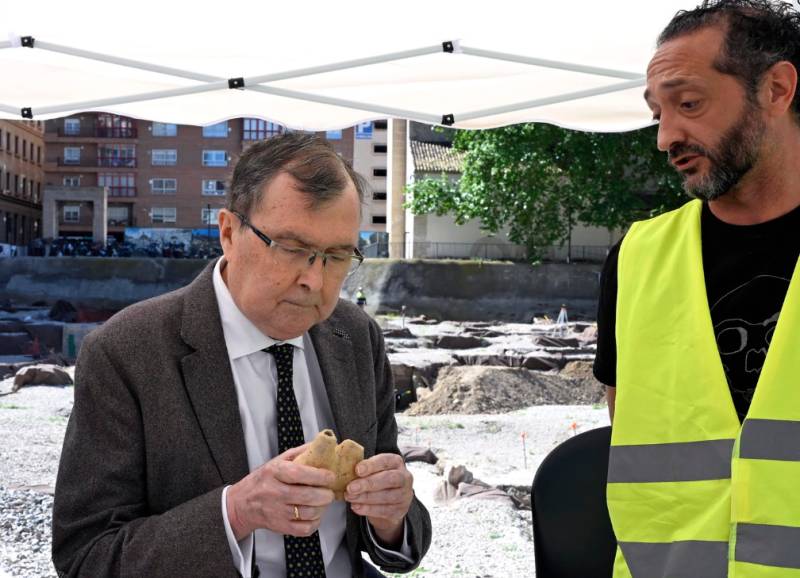
The remains appeared in survey 65, where three bone fragments from a single animal were identified: one complete proximal phalanx and two complete medial phalanges. Before this discovery, only 14 dromedary elements had been documented in Islamic contexts in the south of the Iberian Peninsula, and the San Esteban remains raise that total to 17 known elements. The bones were found complete, well preserved and without visible cut marks, which means they were not used as food. The report concludes that the animal was most likely used as a pack animal, linked to transport and mobility in Islamic Murcia.
Mayor José Ballesta said the work is being carried out carefully to protect what is being found. “The preliminary and absolutely necessary archaeological work is taking place to ensure the integrity of all the findings being made here,” he said during a visit to the site.
Another notable discovery has come from survey 57, where archaeologists have revealed an Andalusian house with a complex internal layout and unusual water drainage systems. The house has double-built walls, a well, two different drains and a small sewer leading into H Street. One drain is linked to the patio, while a second, more modern one includes an atanor, a ceramic channel piece that may have carried water from a higher level, possibly an upper floor.
The excavation has also shown that the home was altered over time, with a partition wall and foundation pit found in the entrance hall. The Ayuntamiento says this helps show not just how the house was built, but how its spaces were organised and how water was managed.
Excavation 71 has meanwhile brought to light a large earthenware jar hidden inside house 30. The vessel was found in an alcove, one of the concealed spaces used for storing valuable objects. Its complete opening is still pending technical authorisation and the restorer’s approval, as proper conservation must first be guaranteed. The Ayuntamiento says that work is expected to take place soon.
Other finds include 12th-century cuerda seca fragments, honey-coloured ataifores, red-painted plaster, a possible kitchen area in house 35 and a possible latrine partition in survey 78. The council says the current phase has already produced material from 13 test pits, with almost 70 still to go, and that the pace of work is continuing as planned.












 Spanish News Today
 Alicante Today
 Andalucia Today

 Archaeologists working at Murcia’s San Esteban site have uncovered the first dromedary remains found in the city, a discovery the Ayuntamiento says opens up new lines of research into the ancient Andalusian suburb of Arrixaca. The find is being described as exceptionally rare in Iberian archaeology from the Islamic period.
 The remains appeared in survey 65, where three bone fragments from a single animal were identified: one complete proximal phalanx and two complete medial phalanges. Before this discovery, only 14 dromedary elements had been documented in Islamic contexts in the south of the Iberian Peninsula, and the San Esteban remains raise that total to 17 known elements. The bones were found complete, well preserved and without visible cut marks, which means they were not used as food. The report concludes that the animal was most likely used as a pack animal, linked to transport and mobility in Islamic Murcia.